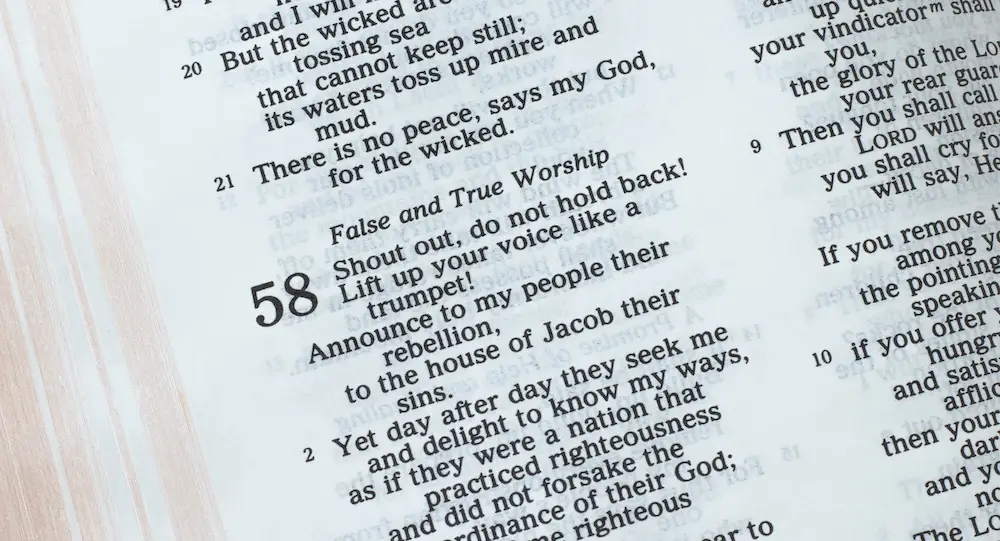
Isaiah 58 – The Kind Of Fasting God Desires
Isaiah 58 gives one of Scripture’s clearest answers to a common question: what kind of fasting actually pleases God? The chapter shows that true fasting is never just about going without food. It is about a heart changed by God, expressed through humility, justice, compassion, generosity, and everyday obedience.
Few passages confront shallow ideas about fasting more directly than Isaiah 58. In this chapter, God speaks to people who were practicing religious discipline outwardly, yet remaining unchanged inwardly. They were fasting, praying, and appearing sincere. But their relationships, motives, and treatment of others revealed that something was deeply wrong.
That is why Isaiah 58 still matters so much today. It reminds us that God is not impressed by empty religious performance. He is not moved simply because we abstained from food for a set number of hours. Biblical fasting is meant to lead us into deeper surrender, greater attentiveness to God, and a transformed life that bears fruit in love.
A Direct Answer From Isaiah 58
The central message of Isaiah 58 is simple: the fasting God desires is not merely external restraint, but inward transformation that results in justice, mercy, and faithfulness. The people in Isaiah’s day wanted God to notice their fasting. Instead, God exposed the gap between their religious practice and their daily conduct.
They asked, “Why have we fasted, and you have not seen it?” (Isaiah 58:3). From their perspective, they were doing what they were supposed to do. They were denying themselves. They were participating in acts of devotion. Yet God made clear that their fasting was disconnected from the kind of life He wanted.
While they fasted, they were still driven by self-interest. They oppressed others. They engaged in conflict. They ignored the needy. Their fasting had become a ritual without repentance, discipline without compassion, and worship without obedience.
The Problem Isaiah 58 Exposes
The problem in Isaiah 58 is not that the people were fasting too much, but that they were fasting wrongly. They expected spiritual credit for self-denial while continuing patterns of selfishness and injustice. God was exposing religious inconsistency.
This is one of the most sobering parts of the chapter. A person can participate in spiritual practices and still remain resistant to God. It is possible to fast and still be proud. To pray and still be harsh. To attend to religious duties and still neglect the vulnerable. Isaiah 58 warns against divorcing devotion from character.
That warning is deeply relevant because religious habits can quietly become performances. We may begin with sincere motives, then slowly drift into measuring spirituality by appearances. If we are not careful, fasting becomes something we do to feel disciplined, look devoted, or seek results, rather than something that opens us to God’s searching work.
Isaiah 58 calls that out directly. God sees beyond the visible practice to the reality of the heart. He is not looking only at whether we skipped meals. He is also looking at whether we are becoming more humble, more honest, more merciful, and more aligned with His heart.
What True Fasting Looks Like
In Isaiah 58:6, God says, “Is not this the kind of fasting I have chosen…” What follows is one of the strongest biblical descriptions of authentic fasting. True fasting is connected to loosening the bonds of wickedness, undoing oppression, sharing bread with the hungry, welcoming the poor, clothing the vulnerable, and refusing to turn away from those in need.
In other words, the fast God chooses is marked by visible fruit. It produces humility instead of self-importance. Justice instead of exploitation. Compassion instead of indifference. Generosity instead of self-protection. Fasting is not treated as unimportant, but as something that should deepen obedience.
That means biblical fasting is never merely private. Even when practiced quietly, it reshapes public life. It affects how we speak, how we work, how we handle conflict, how we use resources, and how we respond to suffering around us.
Fasting Is Meant to Transform Character
Isaiah 58 reveals that fasting affects much more than eating habits. It reaches into attitudes, attention, desires, and relationships. Its purpose is not simply self-denial for its own sake. It is spiritual transformation.
When fasting is approached biblically, it exposes what usually controls us. It reveals impatience, pride, distraction, irritability, fear, or self-reliance. That can feel uncomfortable, but it is part of the gift. Fasting removes normal comforts and can uncover what has been hidden beneath the surface. In that way, it becomes a pathway for repentance and renewed dependence on God.
Just as importantly, true fasting should cultivate greater love. If a person fasts yet becomes more self-absorbed, more judgmental, or less compassionate, Isaiah 58 invites honest reevaluation. The point is not simply to complete a practice. The point is to become the kind of person who reflects the heart of God.
That is why fasting should be joined with prayer, Scripture, confession, and practical care for others. On Fasting Companion, readers exploring prayer and fasting, intermittent fasting and faith, or traditional Hebrew fast periods can benefit from remembering this biblical anchor: fasting is not an isolated technique. It is part of a surrendered life.
Why Isaiah 58 Feels So Relevant Today
Isaiah 58 feels strikingly current because modern culture often reframes fasting in self-centered ways. Many people speak about fasting only in terms of optimization, productivity, self-mastery, or appearance. Even in Christian settings, it can be subtly treated as a way to seem committed or spiritually mature.
This chapter cuts through all of that. It reminds believers that spiritual practices are not ends in themselves. The goal is not appearing disciplined. The goal is becoming transformed.
That does not mean physical discipline is irrelevant. It means discipline is not the final measure. A fast that leaves a person more prayerful, more generous, more honest, and more attentive to the suffering of others is moving in the direction Isaiah 58 describes. A fast that strengthens ego or ignores injustice is missing the point.
For many readers, this chapter is also freeing. It lifts the pressure of performance and redirects attention to faithfulness. The question becomes less, “Did I complete this perfectly?” and more, “Is God changing me through this?”
A Practical Isaiah 58 Checklist
One of the most helpful ways to apply this chapter is to ask concrete questions before, during, and after a fast.
- Am I fasting to seek God, or to prove something?
- Is my heart softening, or am I becoming more self-focused?
- Are my words becoming gentler and more truthful?
- Am I attentive to people in need around me?
- Is this fast leading me toward repentance and obedience?
- Have I connected this fast with prayer, Scripture, and humility?
- Is there any injustice, conflict, or selfish pattern I need to address?
These questions help keep fasting grounded in the purpose Isaiah 58 gives. They also make the practice more realistic. A person may abstain from food and still need to apologize to someone, give generously, or change a harmful pattern. In that sense, fasting becomes deeply practical.
Everyday Faithfulness and the Invitation of Isaiah 58
One of the most overlooked features of Isaiah 58 is how ordinary its vision is. True fasting is connected to everyday faithfulness. It touches work, speech, relationships, generosity, justice, and humility. It prevents fasting from becoming escapism.
This chapter ultimately invites believers into a different kind of spirituality: not one centered on appearance, but one centered on transformation. It describes a life of fasting shaped by sincerity, obedience, compassion, and prayerful attentiveness. That vision remains deeply needed.
If you are using the Fasting Companion app or building a regular rhythm of fasting, let Isaiah 58 remain your guide. Measure the fast not only by what you gave up, but by what God is forming in you. Look for greater humility. Greater love. Greater willingness to serve. Greater sensitivity to sin and to the needs of others.
FAQ
Does Isaiah 58 mean food fasting no longer matters?
No. The passage does not dismiss fasting from food. It corrects the idea that abstaining alone is enough.
What if my fast feels weak or imperfect?
Isaiah 58 calls for sincerity, not performance. Bring your weakness honestly to God and ask Him to shape your heart.
How can I begin fasting in a biblical way?
Start simply, pair fasting with prayer and Scripture, and ask God to produce repentance, compassion, and obedience.
Take a Moment to Reflect
Is there any area of your spiritual life where outward appearance has become more important than inward transformation? Let Isaiah 58 lead you back to the kind of fasting God desires.
Prayer and Scripture Meditation
Father, teach me the kind of fasting that truly honors You. Expose pride, distraction, selfishness, and spiritual performance in my heart. Make my fasting more than outward discipline. Shape me into someone marked by humility, compassion, justice, generosity, and sincere dependence on You. Teach me to seek transformation, not appearance, and draw me closer to Your heart. Amen.
As a final meditation, reread Isaiah 58 slowly. Pay attention to what God says He truly desires. Reflect not only on what you may abstain from, but on who you are becoming. That is the invitation of this chapter, and it is still as necessary now as ever.