
Can I Fast With Gout? Hydration, Flare Fear, and Spiritual Alternatives
Gout can make food fasting feel risky or frightening. This guide offers Christian wisdom for hydration, flare concerns, prayer, and non-food fasting alternatives.
New to fasting? Start with the first row below.
Been at this a while? Skip ahead. Nothing here is locked or gated – read whatever’s useful, in whatever order makes sense for you.
The basics, explained gently – no assumed knowledge.
Gout can make food fasting feel risky or frightening. This guide offers Christian wisdom for hydration, flare concerns, prayer, and non-food fasting alternatives.
A practical Christian guide to choosing what to give up for a spiritual fast, including food and non-food fasts that create space for prayer and reflection.

A gentle Christian guide to using a fast as space for intercessory prayer, with a simple prayer rhythm, discernment questions, and practical ways to carry others before God without pressure.

A gentle Christian guide to modifying a fast when family meals, hospitality, health needs, or caregiving responsibilities require wisdom instead of rigid rule-keeping.

A careful Christian guide to fasting for neurodivergent believers, with attention to routine, sensory needs, safe alternatives, and prayer-centered intention without pressure.

A careful Christian guide to ending a fast with prayer, gratitude, practical wisdom, and a gentle return to ordinary rhythms without guilt or performance pressure.
For when fasting stops being a one-off and starts being a practice.

A practical Christian guide to family-friendly non-food fasts for homes and small groups, with prayerful ideas, safety-conscious boundaries, and simple ways to create space for God together.
A careful Christian guide for breastfeeding and postpartum readers who want to approach fasting with prayer, wisdom, non-food alternatives, and appropriate medical support.

Learn how biblical fasting helps Christians interrupt distraction, slow down, and create space for prayer, reflection, and deeper attentiveness to God.

A gentle Christian guide to fasting during spiritual dryness, with prayerful discernment, non-food options, practical reflection, and encouragement to seek God without pressure.
Isaiah 58 offers one of the Bible’s clearest teachings on fasting. Discover what God says about true fasting and why spiritual transformation matters more than outward ritual.

If you have diabetes, you may wonder whether fasting from food is safe, wise, or even possible. This gentle Christian guide explores how to approach fasting with both faith and care, helping you understand the risks of food fasting, when to seek medical advice, and meaningful alternatives that can support prayer and spiritual growth without compromising your health.
For fasts with more weight – historical practices, intercession, and seasons that ask more of you.
A gentle Christian guide to using a fast as space for intercessory prayer, with a simple prayer rhythm, discernment questions, and practical ways to carry others before God without pressure.

A careful Christian guide for older adults who want to approach fasting with prayer, wisdom, and spiritual intention while honoring health needs and gentler alternatives.
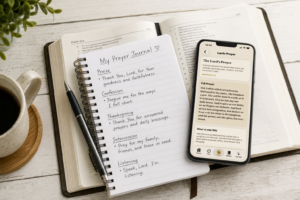
A practical Christian guide to prayer journaling during a fast, with prompts for hunger, distraction, dependence, Scripture reflection, and ending the fast well.

Both the Old and New Testaments should God’s people fasting during seasons of grief and sorrow. Discover the biblical connection between fasting, mourning, prayer, and dependence on God in difficult seasons.
A gentle Christian guide to fasting without legalism, with practical ways to keep prayer, humility, grace, and wisdom at the center of the fast.

Discover how spiritual fasting and prayer can help Christians slow down, reduce distraction, cultivate peace, and create intentional space for God in the middle of anxiety and mental overwhelm.
Fasting resources for pastors, ministry leaders, and small group leaders.
A practical Christian guide to family-friendly non-food fasts for homes and small groups, with prayerful ideas, safety-conscious boundaries, and simple ways to create space for God together.

A practical Christian guide for pastors, small-group leaders, and church teams who want to invite fasting without pressure, protect health-related modifications, and keep prayer at the center.
Discover how spiritual fasting and prayer can help Christians slow down, reduce distraction, cultivate peace, and create intentional space for God in the middle of anxiety and mental overwhelm.
A pastoral guide for ministry leaders who want to invite their church into fasting with biblical clarity, practical wisdom, and grace for different needs.

The Bible contains both private fasting and corporate fasting (or group fasts). Discover the difference between personal fasting and communal fasting and why both still matter today.
Isaiah 58 offers one of the Bible’s clearest teachings on fasting. Discover what God says about true fasting and why spiritual transformation matters more than outward ritual.
Fasting and prayer belong together because Christian fasting was never really about food. It’s a way of turning toward God with more focus — humility, dependence, repentance, desire — for a set period of time.
Without prayer, fasting is just going without something. With prayer, it becomes a spiritual practice.
💡 Quick definition: Fasting is voluntarily abstaining for a spiritual purpose. Prayer is what gives that abstaining its direction. Together, they're a rhythm of emptying and seeking.
Name your fasting purpose. Choose what your fast. Pick a passage to return to. Start your fast.
Let hunger or restlessness turn you back to prayer. Keep it simple: help, guide, forgive, lead.
Close with thanks, not a rush back to routine. Write down what surfaced during your fast.
That’s it. Simple, prayerful, and repeatable – not a formula to perfect.
Everything on this page is here to help you understand fasting and prayer. When you’re ready to actually live it out – day by day, with prompts, prayer and journaling – that’s what the app is for.
If you want to understand fasting more deeply first - the theology, the history, real answers to real questions - that's what the rest of fastingcompanion.com is for.
The Fasting Companion app offers guided fasts, daily prayer, journaling and Scripture built to walk with you through your fast, and into your every day.
Want to put this knowledge into practice? Get a month of premium access to Fasting Companion on us.
Simply use code GRACEMONTH at the App Store checkout.
Discover how the Bible prescribed the science of fasting long before medicine caught up. Scripture, evidence, and the real intersection between the two.
Moses fasted 40 days. He had no idea what insulin was. Daniel fasted in Babylon. He'd never heard of autophagy. Jesus fasted in the wilderness for 40 days before He ever explained metabolic switching to anyone — because no one alive had a word for it yet. Science is only now catching up to what the Bible has always known - that fasting is good for us - body, mind and spirit.
Biblical fasting is the intentional practice of giving up food (or sometimes other comforts) for a period of time to focus more fully on God through prayer, worship and dependence on Him. Throughout Scripture, fasting is connected with seeking God’s guidance, expressing repentance, growing in humility and deepening faith. The purpose is never simply to go without food, but to create space to draw closer to God.
The main purpose is to seek God with focused attention. Christians fast to deepen prayer, express dependence, practice humility, and create intentional space for worship, repentance, discernment, and reflection.
Christians fast to intentionally seek God without the distractions of daily life. Fasting is often combined with prayer, Bible reading and worship as a way of expressing humility, seeking wisdom, repenting of sin or praying for a specific need. While fasting doesn’t earn God’s favour, it can help us become more attentive to His presence and strengthen our dependence on Him.
No. Food fasting is common, but some Christians also practice non-food fasts from distractions or habits. The key is that the fast should create real room for prayer and spiritual attention.
Start small and clear. Choose a brief fast, attach it to prayer and scripture, and keep your purpose simple. A single meal fast with intentional prayer can be a wise beginning.
Yes. Fasting appears throughout the Bible as a way of seeking God with humility, prayer, repentance and dependence. People fasted during times of worship, before making important decisions, in seasons of grief, and when asking God for guidance or intervention.
Some well-known examples include:
While fasting is a common spiritual discipline throughout Scripture, the Bible places the emphasis on drawing closer to God—not simply going without food.
No. Biblical fasting is a spiritual practice, not a diet.
Although people may lose weight while abstaining from food, that is not the purpose of fasting in Scripture. The goal is to humble ourselves before God, seek His presence, devote ourselves to prayer, and allow Him to shape our hearts.
If our primary motivation is physical appearance or dieting, we are pursuing a different goal than the one described throughout the Bible.
Biblical fasting shifts our attention away from ourselves and toward God.
Biblical fasting is a spiritual discipline designed to help people seek God through prayer and dependence on Him. Intermittent fasting is a health practice focused on nutrition, metabolism and physical wellbeing. While both involve periods without food, their goals are different. Someone may practise both, but biblical fasting should always be motivated by spiritual growth rather than physical results.
There’s nothing wrong with wanting to improve your health.
Looking after our bodies is part of good stewardship, and many people work towards healthier lifestyles through balanced nutrition, exercise and medical advice.
However, if your goal is weight loss, it’s generally better to follow a sustainable health plan rather than treating biblical fasting as a diet.
You can certainly become healthier while also practising biblical fasting, but it’s helpful to keep the purposes distinct. Let your health plan serve your physical wellbeing, and let your times of fasting become opportunities to grow spiritually.
If you have diabetes, are pregnant, have a history of eating disorders, or have other medical conditions, speak with your doctor before undertaking a food fast.
Yes—but it’s wise to keep your motivations clear.
Many Christians are working towards better health while also wanting to grow spiritually. Those two goals don’t have to compete with each other.
A practical approach is to:
When your heart is set on seeking God first, any physical changes become secondary rather than the reason you’re fasting.
The first explicit mention of fasting occurs when Moses spent forty days and forty nights on Mount Sinai without eating bread or drinking water while receiving God’s covenant (Exodus 34:28).
Some Bible teachers also see God’s command not to eat from the tree in the Garden of Eden as humanity’s first act of self-denial, although the Bible does not describe this as fasting.
From Moses onward, fasting becomes a recurring practice throughout both the Old and New Testaments, culminating in Jesus’ own forty-day fast and the fasting practices of the early church.
The Bible assumes that believers will fast, but it doesn’t command Christians to fast on a specific schedule. Jesus said, “When you fast,” rather than “If you fast” (Matthew 6:16), suggesting it was a normal spiritual practice. Christians are free to fast voluntarily as an act of devotion rather than obligation, allowing it to flow from a desire to seek God rather than from guilt or legalism.
Jesus taught that fasting should be sincere and focused on God rather than performed to impress others. In Matthew 6:16–18, He instructed His followers to fast quietly and humbly, trusting that God sees what is done in secret. Jesus also fasted Himself for forty days in the wilderness before beginning His public ministry, demonstrating the importance of relying on the Father through prayer and fasting.
The Bible records fasts lasting from part of a day to forty days, but it doesn’t prescribe a standard length. Many people begin with a single meal or one day before attempting longer fasts. The right duration depends on your spiritual purpose, experience and health. If you have any medical conditions, consult your doctor before undertaking a food fast.
Preparation begins with prayer. Decide why you are fasting, how long you will fast and how you’ll use the time to seek God. Plan opportunities for Bible reading and prayer, reduce unnecessary distractions and, for longer food fasts, consider gradually reducing caffeine or heavy meals beforehand. Preparing your heart is just as important as preparing your body.
Fasting doesn’t force God to answer prayers or make Him love us more. Instead, fasting helps us become more focused, humble and dependent on Him. Throughout the Bible, prayer and fasting often appear together because fasting removes distractions and reminds us that our greatest need is God Himself. The power is in God—not in the act of fasting.
Yes. While fasting in the Bible most commonly involved food, many Christians choose to temporarily give up other things that compete for their attention, such as social media, entertainment or technology. Although these aren’t explicitly called “fasts” in Scripture, they can be meaningful ways to remove distractions and create more time for prayer, worship and focusing on God.
Add your email below and we will let you know as soon as it launches.